
How to Budget for a Bathroom Renovation (Step-by-Step): The Complete Planning Guide
Learning how to budget for a bathroom renovation is the single most important step you can take before any work begins. A well-structured budget prevents overspending, keeps your project on schedule, and ensures the finished result matches your original vision without financial stress along the way.
The step-by-step process for budgeting a bathroom renovation involves setting a realistic total spend, breaking costs into clear categories, allocating a contingency fund, and getting accurate quotes before committing to anything.
This guide gives you a complete, practical framework for planning your bathroom renovation budget from scratch. You will learn how costs are structured, where to allocate your money for maximum impact, which expenses are commonly underestimated, and how to make smart decisions at every stage of the planning process.
Whether you are working with £3,000 or £15,000, the principles in this guide apply equally and will help you get the best possible result from your investment.
What Bathroom Renovation Budgeting Actually Involves
Budgeting for a bathroom renovation is the process of forecasting, allocating, and managing all costs associated with updating or replacing elements of your bathroom, from initial planning through to the final snagging check.
A bathroom renovation budget covers four core categories: labour costs, materials and fixtures, structural or remediation work, and a contingency allowance for unexpected findings. Each category carries a different weight depending on the scope of your project and the condition of your existing bathroom.
Understanding the full cost picture before work starts is what separates a smooth renovation from one that runs over budget and causes unnecessary stress. Bathroom renovations are the second most common home improvement project in the UK, and cost overruns are the most frequently reported issue among homeowners who did not plan their budget in sufficient detail from the outset.
Why a Detailed Renovation Budget Protects Your Investment
Skipping thorough budget planning creates financial exposure that compounds as a project progresses. Here is exactly why a structured approach to bathroom renovation budgeting delivers real, measurable benefits.
A well-planned budget establishes a clear ceiling on total spend before you become emotionally invested in materials or designs. It allows you to compare quotes accurately because you understand what each line item should cost. It prevents scope creep, where small additions gradually push the total cost well beyond the original figure. It ensures your contingency fund is in place before work starts, covering unexpected findings like water damage or substandard previous work. It helps you prioritise where quality matters most and where cost-effective alternatives perform just as well. It gives your bathroom fitter a clear brief, which typically results in more accurate quotes and fewer variations during the project.
A well-planned bathroom renovation budget is not a constraint. It is a tool that puts you in control of every decision from start to finish.
How to Budget for a Bathroom Renovation: Step-by-Step
Step 1: Define the Scope of Your Renovation
Before any numbers are involved, define exactly what your renovation includes. A bathroom project can range from a cosmetic refresh to a full strip-out and redesign. The scope determines everything else.
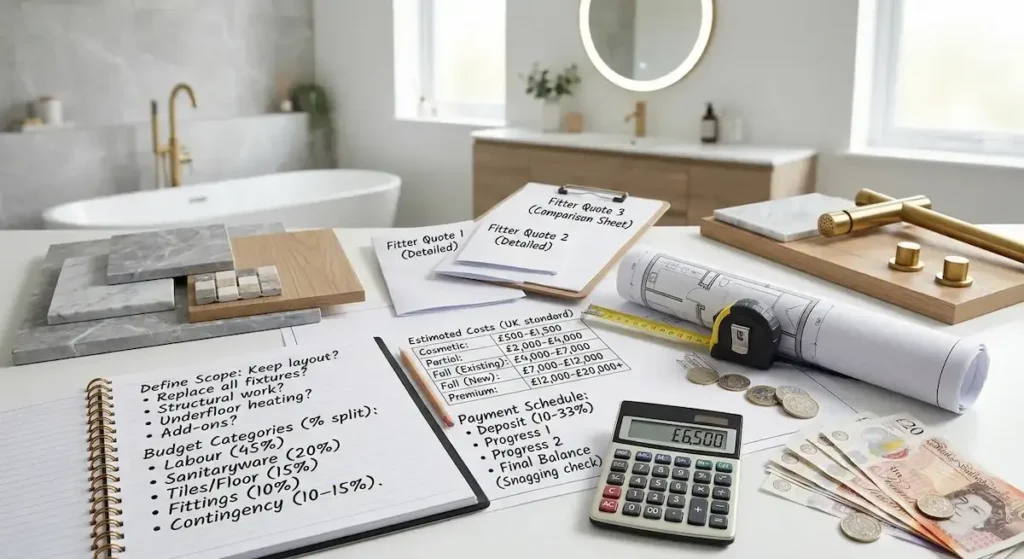
Ask yourself the following questions before proceeding. Are you keeping the existing layout or moving plumbing? Are you replacing all sanitaryware or updating selected pieces? Does the room require structural work such as waterproofing, subfloor repair, or replastering? Will you be adding underfloor heating, new ventilation, or updated lighting?
Write your scope as a clear list. This becomes the foundation of every quote you request and every budget line you create. A clearly defined scope also significantly reduces the risk of scope creep once work has started, as every addition to the project can be assessed against your original brief and priced accordingly before any new work proceeds.
Step 2: Research Realistic Costs for Your Project Type
Bathroom renovation costs in the UK vary significantly based on room size, material quality, and labour rates in your region. The following figures represent typical ranges for a standard family bathroom.
A cosmetic refresh covering paint, accessories, and a new mirror typically costs between £500 and £1,500. A partial renovation involving retiling and new fixtures ranges from £2,000 to £4,000. A full renovation keeping the existing layout costs between £4,000 and £7,000. A full renovation with a new layout and replumbing ranges from £7,000 to £12,000. A premium renovation with luxury finishes starts from £12,000 and can reach £20,000 or more.
These ranges serve as a starting point. Your specific quotes will refine these figures based on local labour rates and the materials you choose. En suite bathrooms typically cost slightly less than family bathrooms due to their smaller footprint, while wet rooms and accessible bathrooms may cost more due to the specialist waterproofing and drainage work involved.
Step 3: Break Your Budget Into Clear Categories
A structured bathroom renovation budget allocates spend across five main categories. Experienced project planners use percentage-based allocation as a starting framework, then adjust based on actual quotes.
Labour costs typically represent 40% to 50% of the total budget. Sanitaryware and fixtures account for 20% to 25%. Tiles and flooring cover 10% to 15%. Fittings, accessories, and lighting take 5% to 10%. The contingency fund should represent 10% to 15% of the total budget.
For a £6,000 bathroom renovation, this means allocating approximately £2,700 for labour, £1,300 for sanitaryware, £750 for tiles, £450 for fittings, and £800 held in reserve as a contingency.
Understanding this breakdown helps you assess whether the quotes you receive are structured sensibly and allows you to identify any category where a contractor may be significantly over or under budget compared to industry norms.
Step 4: Allocate Your Contingency Fund
Every bathroom renovation budget requires a contingency fund of at least 10% and ideally 15% of the total project cost. This is not optional. It is a professional standard followed by experienced project managers across the construction industry.
Contingency funds cover unexpected findings that only become visible once work begins. These commonly include water damage behind existing tiles, subfloor deterioration, inadequate or non-compliant existing plumbing, and remediation of previous poor workmanship.
If your contingency fund goes unused, you have additional budget to spend on finishing touches or simply retain the savings. If unexpected work arises, you are covered without the stress of finding additional funds mid-project.
A contingency fund is particularly important in older properties where the condition of structural elements, pipework, and existing waterproofing is difficult to assess accurately before work begins. In properties built before 1970, a 15% contingency is strongly recommended as a minimum.
Step 5: Get at Least Three Detailed Quotes
Request quotes from a minimum of three qualified bathroom fitters before making any commitment. A professional quote should be itemised, meaning it breaks down labour and materials separately and specifies exactly what work is and is not included.
Avoid accepting quotes that state only a total figure without a breakdown. A detailed quote allows you to compare like for like across different contractors and identify where costs differ and why.
When reviewing quotes, the lowest price is not automatically the best choice. Assess each contractor on their portfolio, references, trade registration, and the clarity of their written quote alongside the total figure. A higher quote from a registered, well-reviewed tradesperson typically represents better value than a lower figure from an unknown contractor with limited evidence of past work quality.
Ask each contractor to confirm whether their quote includes materials disposal, building regulation compliance where applicable, and any plumbing or electrical certification required for your project.
Step 6: Plan Your Payment Schedule
Once you have selected a bathroom fitter and agreed the total cost, structure the payment schedule before work begins. A professional staged payment plan protects both parties and keeps the project progressing in a structured way.
A standard payment structure for a bathroom renovation looks like this. A deposit of 10% to 33% is paid before work begins. A first progress payment is made after first fix plumbing and structural work is complete. A second progress payment follows once tiling, waterproofing, and main fixtures are installed. The final balance is paid only after the work is fully complete and you are satisfied with every aspect of the finished bathroom.
Never release the full balance before the job is finished. The final payment is your most effective tool for ensuring any outstanding work or snagging issues are resolved promptly and to the standard agreed at the outset of the project.
Step 7: Get Everything in Writing
A written contract or detailed written agreement is an essential component of every bathroom renovation project, regardless of the size of the budget or the duration of the work. Your written agreement should include the agreed scope of work, the total quoted cost with a line-by-line breakdown, the agreed payment schedule, the project start and estimated completion dates, the process for handling variations and additional work, and the workmanship guarantee terms offered by the contractor.
A written agreement protects both you and your bathroom fitter. It creates a clear record of what was agreed, prevents misunderstandings about scope or cost, and provides a formal basis for resolving any disputes that may arise during or after the project.
Expert Tips for Getting the Most From Your Bathroom Renovation Budget
Prioritise Waterproofing and Plumbing Over Aesthetics
The elements of a bathroom renovation that you cannot easily see are the ones that matter most. Waterproofing membranes, properly installed tanking, and correctly fitted plumbing form the foundation of a bathroom that will last 15 to 20 years without problems. Cutting costs on these elements to spend more on visible finishes is a trade-off that consistently leads to expensive remediation further down the line.
Investing properly in your waterproofing and plumbing at the outset is the single most cost-effective decision you can make across the entire renovation, as correct installation prevents the damp, mould, and structural damage that poor workmanship in these areas reliably causes over time.
Choose Mid-Range Sanitaryware for the Best Value
The sanitaryware market has three distinct tiers: budget, mid-range, and premium. Budget sanitaryware from entry-level ranges often shows quality limitations within three to five years of installation. Premium ranges carry a significant price premium for marginal practical gains over a well-chosen mid-range product.
Mid-range sanitaryware from established bathroom brands consistently offers the best combination of build quality, aesthetic range, guarantee terms, and value for money for most renovation projects. Leading mid-range bathroom brands typically offer five- to ten-year guarantees on ceramic and acrylic products, which provide genuine long-term assurance alongside competitive pricing.
Use Larger Format Tiles Strategically
Larger format tiles cost more per tile but require fewer tiles overall and less grout, which reduces both material costs and installation time. In a small to medium bathroom tiles measuring 600mm by 300mm or 600mm by 600mm can make the space feel larger while keeping the overall tiling budget competitive.
Larger format tiles also reduce the visual busyness of a bathroom space, which is particularly beneficial in compact rooms where a large number of grout lines can make the space feel smaller and more cluttered than it actually is.
Time Your Purchase of Fixtures and Fittings
Bathroom retailers in the UK run significant promotional events in January, during spring bank holidays, and in the autumn. Purchasing sanitaryware and fittings during these periods can deliver savings of 20% to 40% on standard retail pricing. Coordinate your purchasing timeline with your renovation schedule to take advantage of these windows.
Planning your purchases three to four months ahead of your renovation start date gives you the flexibility to take advantage of sale events, order items with longer lead times, and check that every product is in stock and correct before your installation date arrives.
Keep the Existing Plumbing Layout Where Possible
Moving the position of your toilet, basin, or bath requires replumbing and potentially rerouting soil pipes, which can add 20% to 30% to the total cost of your renovation. Where the existing layout is functional and your design goals can be achieved without relocating major fixtures, keeping plumbing in its current position is one of the most effective ways to manage costs without compromising the quality or impact of the finished bathroom.
If a layout change is genuinely necessary to achieve your design goals or improve the functionality of the space, factor the additional plumbing costs accurately into your budget from the start rather than discovering them mid-project.
What to Avoid When Budgeting for a Bathroom Renovation
Buying Fixtures Before Receiving Quotes
Purchasing sanitaryware and fixtures before receiving contractor quotes creates a mismatch between your specification and your budget. A contractor’s quote is based on the specific products, layout, and scope you present to them. Buying products first without a confirmed budget can result in fixtures that exceed what your overall spend can accommodate once labour and other costs are added.
The correct sequence is to define scope, receive and compare itemised quotes, confirm your total budget, and then purchase fixtures within the budget confirmed by your quotes.
Underestimating Labour Costs
Labour is consistently the most underestimated cost category in bathroom renovation budgets. Many homeowners focus heavily on the visible costs of tiles, sanitaryware, and fittings while assuming labour will be a minor proportion of the total. In practice, labour accounts for 40% to 50% of a standard bathroom renovation budget. Setting unrealistic expectations about labour costs leads to budget shortfalls that either compromise the quality of materials or result in the project stalling before completion.
Ignoring the Hidden Costs of a Bathroom Renovation
Several common costs are frequently overlooked when homeowners prepare their initial bathroom renovation budgets. Waste disposal and skip hire add to the overall project cost and are not always included in contractor quotes. Building control fees apply when a new bathroom is being created or significant structural changes are being made. Electrical compliance certification is required when new circuits are installed. Plastering and decoration costs are sometimes treated as separate to the main renovation quote. Temporary alternative bathroom facilities may be needed during a longer renovation if your only bathroom is out of use.
Reviewing your quote against this list and confirming whether each item is included or excluded is an important step before finalising your bathroom renovation budget.
Smart Budget Allocation vs Common Planning Gaps
Reserving a contingency fund of 10% to 15% covers unexpected findings without financial stress. Allocating 40% to 50% of the total budget to labour keeps expectations realistic about what the remaining budget can achieve on materials. Assessing contractor value rather than choosing the cheapest quote produces better quality results with fewer costly variations. Getting quotes before purchasing fixtures aligns your product specification with your confirmed budget. Using a written contract throughout protects both parties and provides clear resolution procedures. Accounting for layout change costs from the outset prevents budget shock when replumbing adds 20% to 30% to the project total.
A Strong Budget Makes Every Stage of Your Renovation Easier
Knowing how to budget for a bathroom renovation gives you clarity, confidence, and control before a single tile is removed. The step-by-step approach covered in this guide, from defining scope and researching costs to building your contingency fund and structuring staged payments, applies to every bathroom project regardless of size or specification.
The most successful bathroom renovations are almost always the ones that were planned most carefully. When your budget is accurate, your quotes are detailed, and your payment schedule is agreed in writing, the entire project runs more smoothly for everyone involved.
Start your bathroom renovation budget today using the framework in this guide, and approach every stage of your project from a position of confidence and financial clarity.
Frequently Asked Questions
What is a realistic budget for a bathroom renovation in the UK?
A realistic budget for a full bathroom renovation in the UK is between £4,000 and £8,000 for a standard family bathroom with a competent local tradesperson and mid-range materials. Smaller en suite bathrooms can be renovated for £2,500 to £4,500, while larger bathrooms with premium finishes or significant plumbing changes can reach £12,000 or more. The best starting point is obtaining at least three itemised quotes after defining your renovation scope clearly.
How much should I set aside for unexpected costs in a bathroom renovation?
You should set aside a contingency fund of at least 10% and ideally 15% of your total bathroom renovation budget for unexpected costs. On a £6,000 project, this means keeping £600 to £900 in reserve. Unexpected costs commonly include water damage found behind existing tiles, subfloor issues, or remediation of previous non-compliant plumbing work.
What costs the most in a bathroom renovation?
Labour typically represents the largest single cost in a bathroom renovation, accounting for 40% to 50% of the total project budget. Sanitaryware, tiling, and specialist work such as underfloor heating installation are the next most significant cost categories. Moving the position of plumbing or drainage adds considerable cost because it requires replumbing and potentially new soil pipe runs.
How can I reduce the cost of a bathroom renovation without cutting quality?
The most effective ways to reduce bathroom renovation costs without compromising quality include keeping the existing plumbing layout rather than moving fixtures, choosing mid-range sanitaryware over premium brands, using larger format tiles which reduce installation time, purchasing fixtures during seasonal sales, and completing preparation work such as clearing the room yourself before the fitter arrives.
Should I buy my own bathroom fixtures or let the fitter supply them?
Both approaches are valid, but each has practical implications. Supplying your own fixtures gives you greater control over product selection and cost, and allows you to take advantage of sales. However, if a product you supply arrives damaged or incorrect, the resolution falls to you and can delay the project. A fitter who supplies materials takes responsibility for sourcing, delivery, and any product issues, which simplifies project management but typically comes at a higher material cost.
How long does a bathroom renovation take and how does that affect the budget?
A standard full bathroom renovation takes between five and ten working days for an experienced bathroom fitter working alone, or three to seven days for a two-person team. Longer project timelines mean higher labour costs, so complexity and project scope directly influence both duration and budget. Projects involving significant plumbing relocation, custom tiling patterns, or structural remediation work take longer and should be budgeted accordingly.
Is it worth renovating a bathroom on a tight budget?
Renovating a bathroom on a tight budget is absolutely worthwhile when the right priorities are in place. Focus your available funds on waterproofing, plumbing integrity, and durable surface materials rather than premium brand fixtures or decorative accessories. A well-executed renovation using mid-range products and skilled labour will outperform an expensive renovation with poor workmanship every time.
How do I know if my bathroom renovation quote is fair?
A fair bathroom renovation quote is itemised, clearly distinguishes between labour and material costs, and aligns with the industry standard ranges for your project type and region. Compare at least three quotes from registered tradespeople and ask each fitter to explain any significant differences in their pricing. A quote that is substantially lower than the others deserves careful scrutiny, as it may indicate lower quality materials, subcontracted labour, or an incomplete scope of work.