Good bathroom lighting rarely gets the attention it deserves until it’s wrong. A single overhead bulb that throws harsh shadows across your face while shaving, or a dim glow that makes the whole room feel flat and grey, can undo even the most expensive tile and fixture choices. The fix isn’t one bigger light to get bathroom lighting ideas. It’s layering several types of lighting so the room works for every task it’s actually used for.
This guide breaks down the three core layers of bathroom lighting ideas used by UK designers, covers IP ratings and safety zones, and walks through practical ideas for everything from a small ensuite to a statement family bathroom. Whether you’re planning a full overhaul or working lighting into a bathroom design wolverhampton project, these principles apply to any UK bathroom.
The Three Layers of Bathroom Lighting
Most bathrooms that feel “off” are only using one layer of light instead of three. Professional lighting design splits a room into task lighting, ambient lighting, and statement (or accent) lighting, each doing a different job.
- Task lighting focuses bright, shadow-free light exactly where you need it, around the mirror, basin, or shaving area
- Ambient lighting fills the room with a soft, even general glow, usually from ceiling spotlights or a central fitting
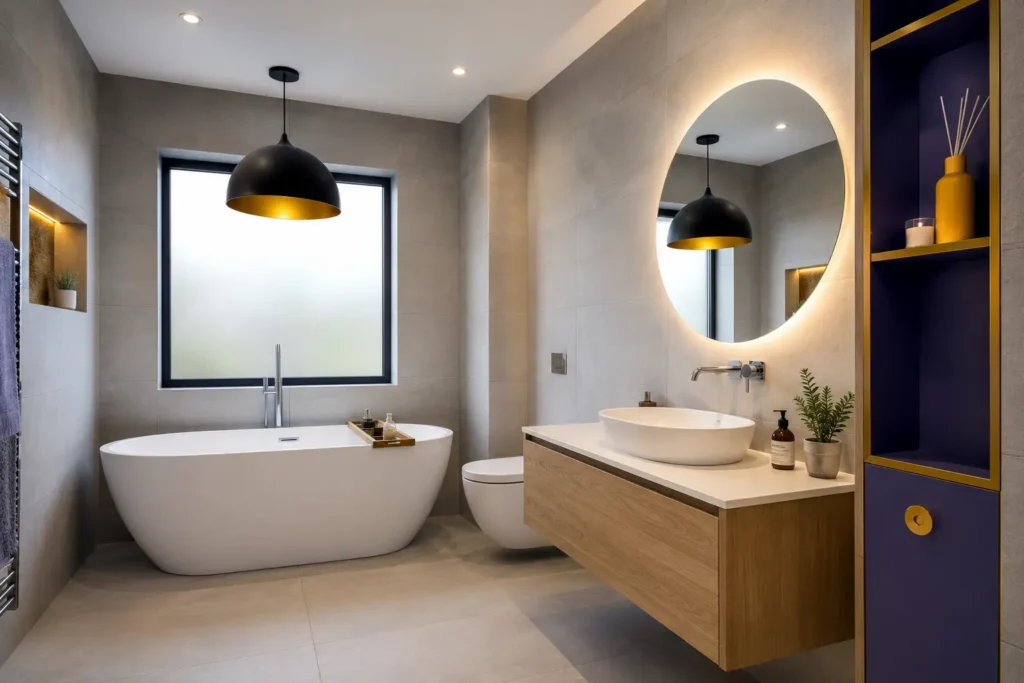
- Statement lighting adds visual interest and personality, through pendants, wall sconces, or decorative fittings
A bathroom with only ambient lighting tends to feel flat. One with only task lighting feels clinical. Combining all three is what makes a space feel both functional and considered.
Task Lighting: Getting the Mirror Zone Right
Task lighting matters most around the mirror, since this is where most daily routines happen, shaving, applying makeup, checking skin. The biggest mistake in UK bathrooms is a single downlight directly above the mirror, which casts shadows under the eyes, nose, and chin.
Better Approaches to Mirror Lighting
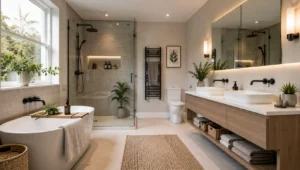
- Side-mounted wall lights either side of the mirror, at roughly eye level, give the most even, shadow-free face lighting
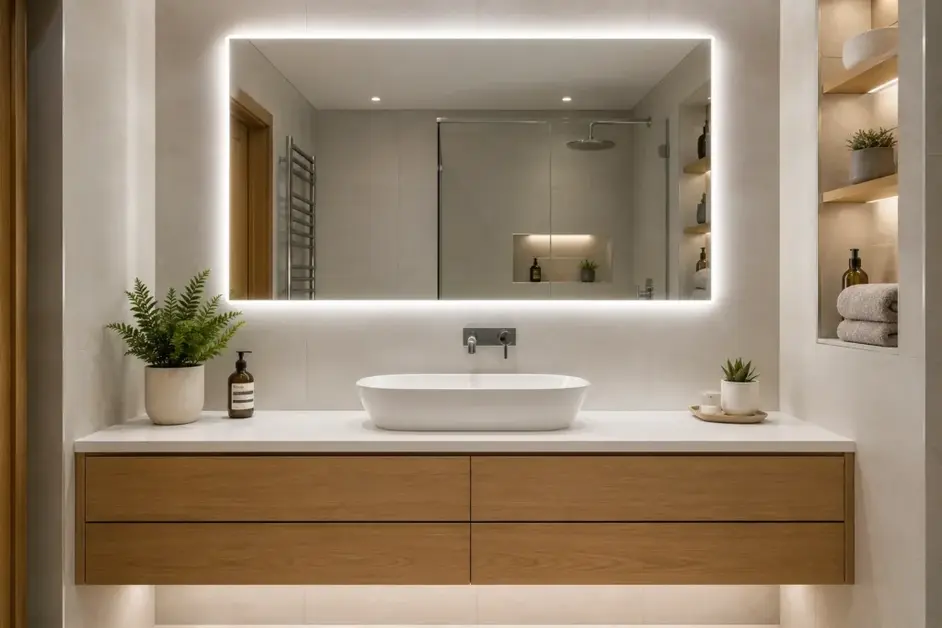
- Backlit or illuminated mirrors with integrated LED strips around the edge have become one of the most popular upgrades in UK bathroom renovations, since they avoid additional wall fittings entirely
- Demister mirrors with built in lighting combine two functions, useful in smaller spaces where wall space is limited
For a small bathroom renovation wolverhampton project, an illuminated demister mirror is often the single most space-efficient lighting upgrade available, since it removes the need for separate wall sconces while still solving the shadow problem properly.
Ambient Lighting: Setting the General Mood
Ambient lighting fills the rest of the room and is usually the layer people think of first, but it works best when it’s not the only layer. Recessed ceiling spotlights, spaced evenly across the ceiling, remain the most common ambient solution in UK bathrooms because they’re unobtrusive and IP rated for wet areas.
Dimmable systems are worth the small extra cost in almost every case, since the ability to soften the light for an evening bath versus brightening it for a morning routine makes the room far more versatile.
Statement Lighting: Where Personality Comes In
This is the layer most UK bathrooms skip entirely, and it’s usually the easiest way to make a renovated bathroom feel genuinely designed rather than just functional. Statement lighting works particularly well in luxury bathroom renovation wolverhampton projects, where a single striking fixture can anchor the whole room’s character.
Popular Statement Lighting Ideas
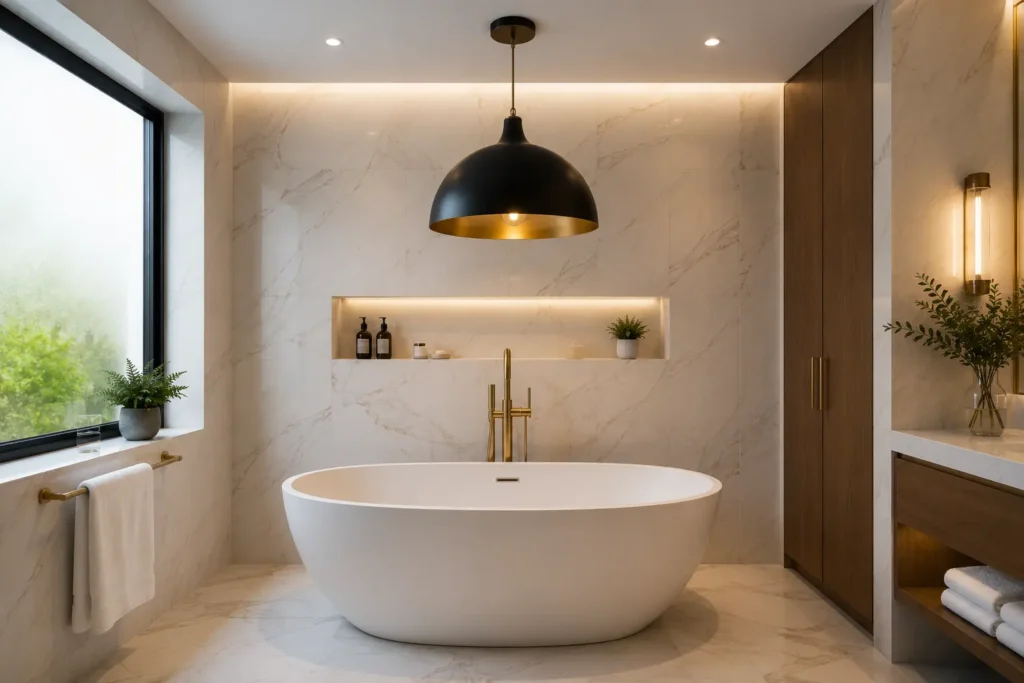
- A pendant light suspended above a freestanding bath, positioned well clear of any water splash zone
- Wall sconces in brass, matte black, or chrome finishes flanking a mirror for both task and visual interest
- A decorative chandelier-style fitting in larger family bathrooms with high ceilings
- Coloured or warm-toned LED strip lighting along a feature wall or behind a bath panel
- Industrial-style wall lights paired with exposed metro tiling for a more characterful finish
Bathroom lighting ideas with one well-chosen statement fixture often photographs and feels more expensive than a bathroom with three times the lighting budget spread evenly and without any focal point.
IP Ratings and Bathroom Lighting Zones: What UK Regulations Require
This is the part most lighting guides skim over, but it’s genuinely important for safety and for passing building regulations. UK bathrooms are divided into zones based on proximity to water, and each zone requires a minimum Ingress Protection (IP) rating.
| Zone | Location | Minimum IP Rating |
| Zone 0 | Inside the bath or shower itself | IP67 or IP68 |
| Zone 1 | Directly above the bath or shower, up to 2.25m | IP65 |
| Zone 2 | Area extending 0.6m beyond the bath or shower edge | IP44 |
| Outside Zones | Areas well away from water sources | No minimum IP rating |
Getting this wrong isn’t just a regulatory issue, it’s a genuine electrical safety risk. Any bathroom plumbing wolverhampton or electrical contractor working on a renovation should confirm IP ratings for every fixture before installation, particularly in wet rooms or shower enclosures.
Wet Rooms and Lighting Zones
A wet room installation wolverhampton project requires particularly careful lighting planning, since the entire floor area can be considered a wet zone depending on the drainage design. Recessed IP65 rated downlights are typically used throughout wet rooms rather than mixing zones, since the open layout makes splash distance harder to predict.
Lighting for Ensuites, Small Bathrooms, and Accessibility
Ensuite Lighting
An ensuite bathroom renovation wolverhampton often benefits from softer, warmer lighting than a main family bathroom, since ensuites are frequently used at night without waking a partner. Dimmable warm white LEDs around 2700K, combined with a small night-light style fitting near floor level, work well for this.
Small Bathroom Lighting Tricks
Small bathrooms benefit from lighting that visually expands the space rather than just illuminating it. Wall-mounted sconces instead of bulky ceiling fittings, combined with an illuminated mirror, keep ceiling lines clean and make compact rooms feel taller.
Accessibility and Disabled Bathroom Lighting
For disabled bathroom adaptations wolverhampton, lighting needs to prioritise clarity and consistency over mood. Even, bright ambient lighting without strong shadows reduces fall risk, while clearly lit switch plates positioned at accessible heights matter as much as the fixtures themselves.
How Tiling and Surfaces Affect Lighting Choices
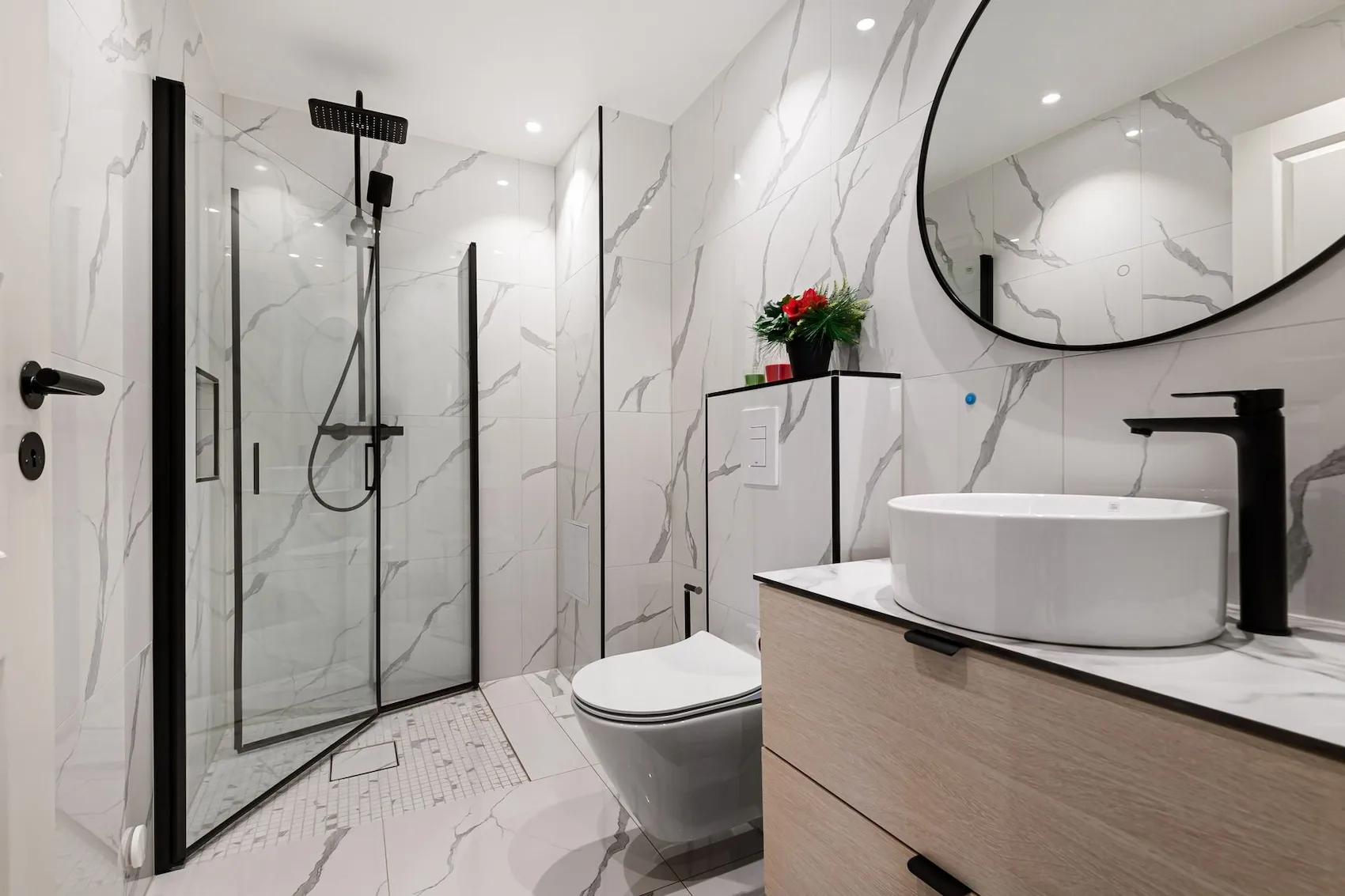
Light interacts heavily with surface finish, which is something often overlooked during planning. Glossy bathroom tiling wolverhampton finishes reflect more light and can amplify a bright ambient layer, sometimes to the point of glare, while matte tiles absorb more light and may need slightly stronger fittings to achieve the same brightness. Dark tiling, increasingly popular in UK bathrooms, generally needs at least one additional light source compared with a lighter palette to avoid the room feeling dim.
Coordinating Lighting With Bathroom Suites and Fixtures
When planning bathroom suites wolverhampton alongside new bathroom lighting ideas, it helps to think about finish coordination. Chrome fittings generally pair best with cooler-toned LEDs, while brass or matte black fixtures tend to suit warmer color temperatures around 2700K to 3000K. A shower replacement Wolverhampton project is also a natural moment to upgrade the shower zone’s lighting since access to the ceiling and walls is already opened up during the work.
Bathroom Lighting Across Wolverhampton
Lighting needs vary noticeably by property type and age across the city. Bathroom renovation Wolverhampton city centre projects, often in flats and converted properties, tend to favor compact illuminated mirrors and recessed downlights due to limited ceiling height and wall space. Larger period properties common to bathroom renovation tettenhall and bathroom renovation penn wolverhampton frequently have higher ceilings suited to statement pendant fittings.
In bathroom renovation bilston and bathroom renovation wednesfield, older electrical systems sometimes need rewiring before modern dimmable or smart lighting can be fitted safely. Bathroom renovation bushbury and bathroom renovation whitmore reans projects regularly combine lighting upgrades with broader rewiring work for this reason.
Homes in bathroom renovation heath town and bathroom renovation blakenhall wolverhampton have shown growing demand for warm-toned illuminated mirrors as a simple, high impact upgrade. Bathroom renovation oxley wolverhampton and bathroom renovation fallings park projects often pair new lighting with wet room conversions, given the overlapping electrical work involved.
Further out, bathroom renovation pendeford, bathroom renovation codsall, bathroom renovation perton, and bathroom renovation wombourne tend to involve larger detached properties where statement lighting, pendants, sconces, and feature LED strips get used more freely thanks to bigger room sizes and higher ceilings.
Practical Lighting Tips for Any UK Bathroom
- Always check IP ratings against the zone before buying any fixture, not after
- Use warm white (2700K to 3000K) for relaxing ambient and statement lighting, and cooler white (4000K) for task lighting around mirrors
- Add a dimmer switch wherever building regulations and the fixture allow it
- Avoid placing a single downlight directly above a mirror; use side lighting instead to prevent shadows
- In dark-tiled bathrooms, plan for slightly more light sources than a lighter palette would need
- Consider a small night-light circuit for ensuites used during the night
Frequently Asked Questions
What is the best lighting for a bathroom mirror in the UK?
Side-mounted wall lights at eye level either side of the mirror, or an illuminated LED backlit mirror, give the most even, shadow-free light for tasks like shaving or applying makeup.
What IP rating do I need for bathroom lighting?
It depends on the zone. Lights inside a bath or shower need IP67 or IP68, lights directly above need IP65, and lights further away in drier zones can use lower or no minimum IP rating.
Can I use a pendant light in a bathroom?
Yes, as long as it’s positioned outside the splash zone and meets the required IP rating for its location, usually IP44 or higher depending on proximity to water.
Should bathroom lighting be warm or cool white?
Warm white around 2700K to 3000K suits ambient and statement lighting for a relaxing feel, while cooler white around 4000K works better for task lighting where accuracy matters, such as around mirrors.
Do dimmer switches work with all bathroom lights?
Not always. LED fixtures need to be specifically dimmable compatible, and the dimmer switch itself must be rated for use in a bathroom’s electrical zone, so checking compatibility before installation is important.